
Buying a pre-owned boat can provide excellent value, especially when you find a vessel that has been properly maintained. However, appearances alone cannot tell you whether a boat is mechanically sound, structurally safe, or affordable to maintain.
Before making an offer, take time to evaluate the boat’s condition, history, and equipment. A practical Used Boat Buyer’s Inspection Checklist helps organize the process and reduces the chance of overlooking important details.
Here are ten essential areas every prospective boat owner should investigate.
1. Hull Condition
Begin with the hull because it forms the boat’s primary structure. Look for cracks, deep gouges, blistering, dents, corrosion, and signs of previous impact damage.
The appropriate inspection depends on the construction material. Fiberglass may show stress cracks or suspicious repair patches. Aluminum may have corrosion or damaged welds. Wooden hulls may have rot or deteriorating seams.
Pay particular attention to the keel, transom, and areas around fittings. Serious structural concerns should be assessed by a qualified marine surveyor before purchase.
2. Engine Performance
The engine is often one of the most expensive components to repair or replace. Ask for service records and details about previous mechanical work.
Look for fluid leaks, damaged hoses, corrosion, loose belts, and signs of overheating. When possible, observe a cold start and listen for abnormal noises.
A qualified marine mechanic can perform more detailed checks, which may include diagnostic testing, compression or leak-down testing where appropriate, and examination of the cooling and fuel systems.
Do not rely solely on an engine that starts successfully during a brief demonstration.
3. Maintenance Records
Maintenance documentation helps you understand how the previous owner cared for the boat.
Look for records of oil changes, scheduled servicing, impeller replacement where applicable, battery replacement, corrosion prevention, and repairs.
Missing records do not automatically mean a boat is unsuitable, but they increase uncertainty. You may need to budget for additional inspections or preventive servicing.
Ask direct questions about recurring faults, accidents, periods of storage, and major component replacements.
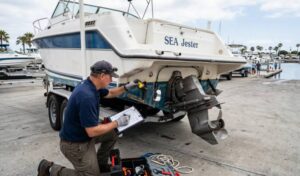
4. Electrical System
Electrical faults can cause inconvenience and, in some cases, serious safety hazards.
Test the navigation lights, bilge pumps, dashboard gauges, horn, charging system, and installed electronics. Examine wiring for damaged insulation, corrosion, loose terminals, and improvised connections.
Check the batteries and their mounting arrangements. Ask whether the electrical system has been modified and whether those changes were professionally completed.
If you find exposed wiring or repeated electrical failures, have a marine electrician assess the system.
5. Fuel System
Fuel leaks and poorly maintained fuel components deserve immediate attention.
Inspect accessible hoses, connections, filters, tank areas, and ventilation arrangements. Look for deteriorated hoses, staining, corrosion, and strong fuel odors.
Never ignore a suspected fuel leak or attempt to operate the boat until the problem has been properly addressed.
A technician should evaluate questionable components and verify that the fuel system meets the requirements applicable to the boat.
6. Steering and Propulsion
Check that the steering wheel or tiller operates smoothly and that the controls respond as expected.
Inspect the propeller, shaft, outboard mounting, visible drive components, and associated hardware. Look for impact damage, unusual movement, corrosion, and evidence of improper repairs.
A damaged propeller may indicate an isolated problem, but it can also justify checking the shaft, gearcase, or other affected components.
During an appropriate sea trial, evaluate steering response and shifting behavior without placing passengers at unnecessary risk.
7. Deck, Seating, and Interior
A boat’s interior can reveal evidence of moisture, neglect, and poor storage conditions.
Inspect flooring, seats, upholstery, hatches, railings, storage compartments, and deck fittings. Check for soft spots, loose hardware, mold, persistent dampness, and water stains.
Open compartments whenever possible. Look for standing water, damaged wiring, and neglected areas that may not be visible during a casual walkthrough.
Cosmetic defects may be manageable, but unexplained structural softness or extensive water damage requires further investigation.
8. Safety Equipment
Confirm that the boat has appropriate life jackets, fire extinguishers, sound-signaling equipment, navigation lights, and other safety items required for its type and intended use.
Inspect equipment condition and expiration or service dates where applicable. Check whether items are accessible and suitable for the number of people expected aboard.
You may need to purchase additional equipment after taking ownership, so include these expenses in your budget.
9. Trailer and Documentation
If the sale includes a trailer, inspect its tires, brakes, bearings, lights, frame, hitch, winch, and tie-down points.
Then review ownership documents, registration, identification numbers, and any applicable lien or title information. Requirements differ by location, boat type, and registration status.
Confirm that the seller has the legal authority to transfer ownership and that the boat’s identification details match the available documents.
10. Sea Trial and Total Cost
A sea trial can help reveal operating issues that are difficult to identify while the boat is stationary. Observe starting, steering, acceleration, temperature readings, vibration, and handling under suitable conditions.
Afterward, estimate the complete cost of ownership. Include fuel, insurance, servicing, storage, registration, repairs, and replacement equipment.
A low purchase price is not necessarily a bargain if major repairs are imminent.
A Better Way to Evaluate Your Next Boat
A structured inspection helps you compare boats consistently and make decisions based on evidence rather than excitement.
Before visiting a seller, review the Used Boat Buyer’s Inspection Checklist and prepare questions about maintenance, condition, equipment, and ownership costs.
Take photographs with permission, record defects, and arrange professional assessments when necessary. If the seller refuses reasonable inspection requests, consider whether the uncertainty is worth the risk.
With careful preparation, you can approach the buying process more confidently and select a boat that fits your plans, expectations, and budget.